
How to Make an Overlooked Garden Feel Private Again
“The neighbours built a loft conversion. Now their window looks straight down into my garden.”
If you’ve ever said something like that, you’re in good company. It’s one of the things I’m asked about most often, and I understand why it gets under people’s skin. A garden is meant to be the one place you can sit without being on show. When a new window appears above the fence, even a garden you’ve loved for years can start to feel like it isn’t quite yours any more.
The good news is that an overlooked garden is one of the most solvable problems in garden design. It rarely needs a fortress. It needs a few well-placed decisions, and most of them are about where you sit rather than where your boundary is.
Why a taller fence rarely fixes an overlooked garden
The first instinct is almost always to go up. Higher fence, trellis on top, job done.
The trouble is geometry. In most back gardens a fence or wall can go up to two metres without planning permission, and that’s a sensible height for privacy from someone standing in the next garden. But a loft or first-floor window isn’t standing in the next garden. It’s looking down. From up there, the line of sight drops steeply, clears the top of a two-metre fence with ease and lands right in the middle of your lawn.
So you can spend a good deal on a taller boundary, lose light to your borders in the process, and still be in full view when you sit down with your coffee. Which is a lot of fence for not much privacy.
What works is turning the question around. Not “how do I hide the whole garden?” but “where do I actually sit, and what is directly above me?”
Start with where you sit
Before anything is built or planted, I stand where the window is (or as close as I can get, usually on the client’s patio squinting upwards, which the neighbours find fascinating) and work out what it can really see.
You’ll often find it’s less than it feels. A window looks down into a cone of the garden, not all of it. The corner beside the house, the space under an existing tree, the far end behind a shed: some parts are already out of view.
Then the seating goes where you’d most like to be, and the privacy is built around that spot. One well-sheltered place you love will do more for you than a whole garden that’s partly screened.
Cover above your seat: pergolas and canopies
If the view comes from above, the most effective answer is something above you.
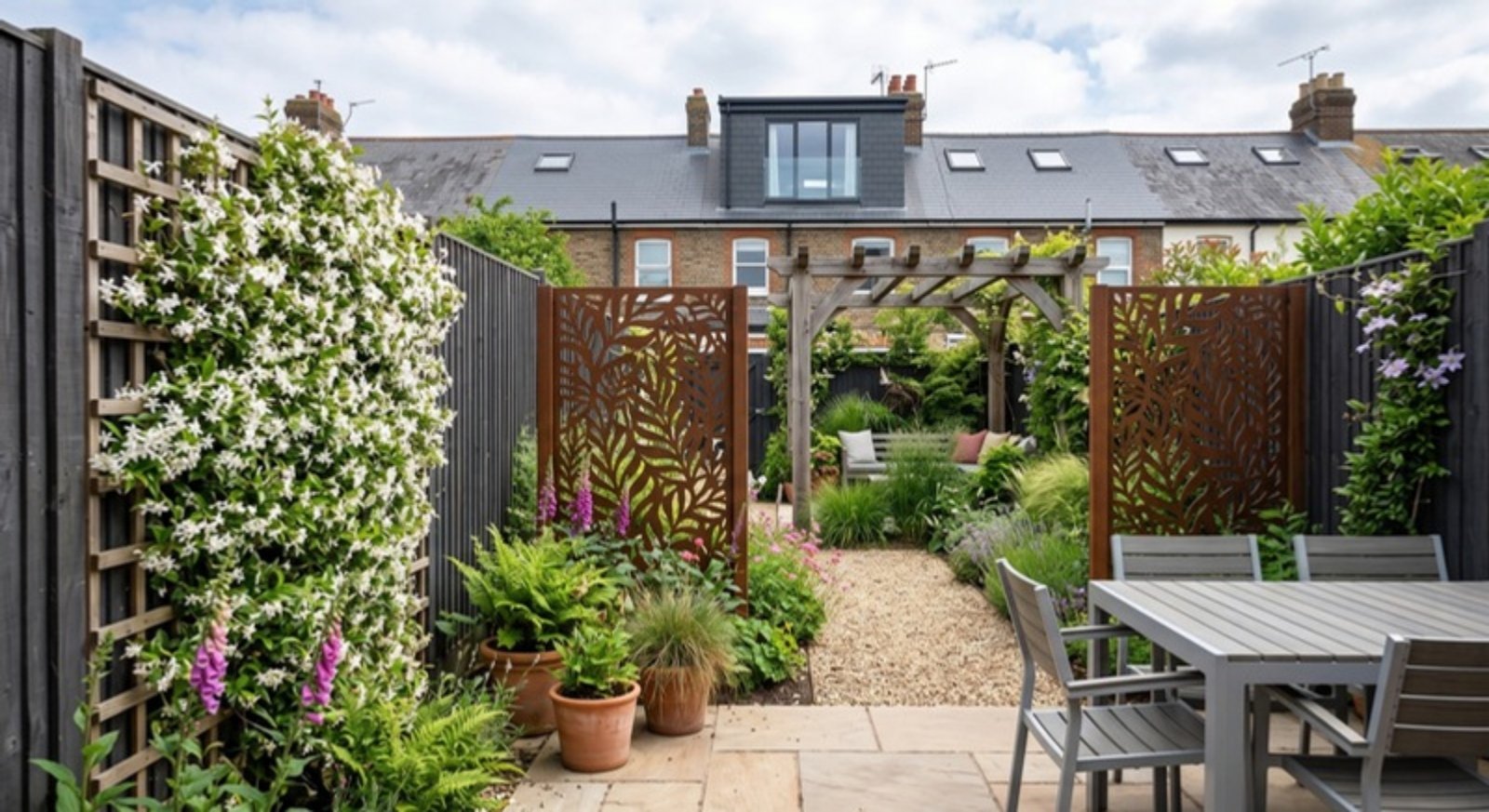
A pergola with a planted or slatted roof is my favourite, because it doesn’t feel like screening at all. It feels like a room. Timber or aluminium louvres can be angled to block a view from one direction while still letting light through, and a climber across the top turns it into dappled shade.
For climbers, think about the season you need it most:
- Wisteria sinensis gives a wonderful ceiling in late spring and summer, then drops its leaves in winter, which is exactly when you’re less likely to be sitting out and most likely to want the light.
- Trachelospermum jasminoides (star jasmine) is evergreen and scented in July, so the cover stays all year. It’s slower to fill a roof, so it rewards a little patience.
- A grapevine, Vitis vinifera, grows quickly, gives big leaves and, in a warm Sussex summer, the occasional bunch of grapes to feel smug about.
A practical note that gives peace of mind: close to a boundary, structures generally need to stay within set heights to avoid needing planning permission. I check this at the design stage so there are no surprises later.
Sail shades and fabric canopies are a lighter option for a smaller space. They’re easy to take down in winter and very good at hiding you from one particular window.
Trees that screen from above
Trees are the other way to put a canopy between you and the window, and they bring so much more with them: birdsong, blossom, movement, shade on a hot afternoon.
Pleached trees are the designer’s secret here. They’re trees trained with a clear stem and a flat panel of branches on top, so they sit like a hedge on stilts. Planted just inside a fence, they add screening from around two metres up to about four, which is exactly the zone a first-floor or loft window looks through, without taking up any room at ground level.
- Pleached hornbeam (Carpinus betulus) copes with both Sussex chalk and heavy Wealden clay. Clipped hornbeam often holds on to its dry brown leaves through winter, so it keeps some screening when you need it.
- Holm oak (Quercus ilex) is evergreen and shrugs off coastal wind and salt, which makes it a good choice nearer the sea in Worthing, Shoreham or Littlehampton.
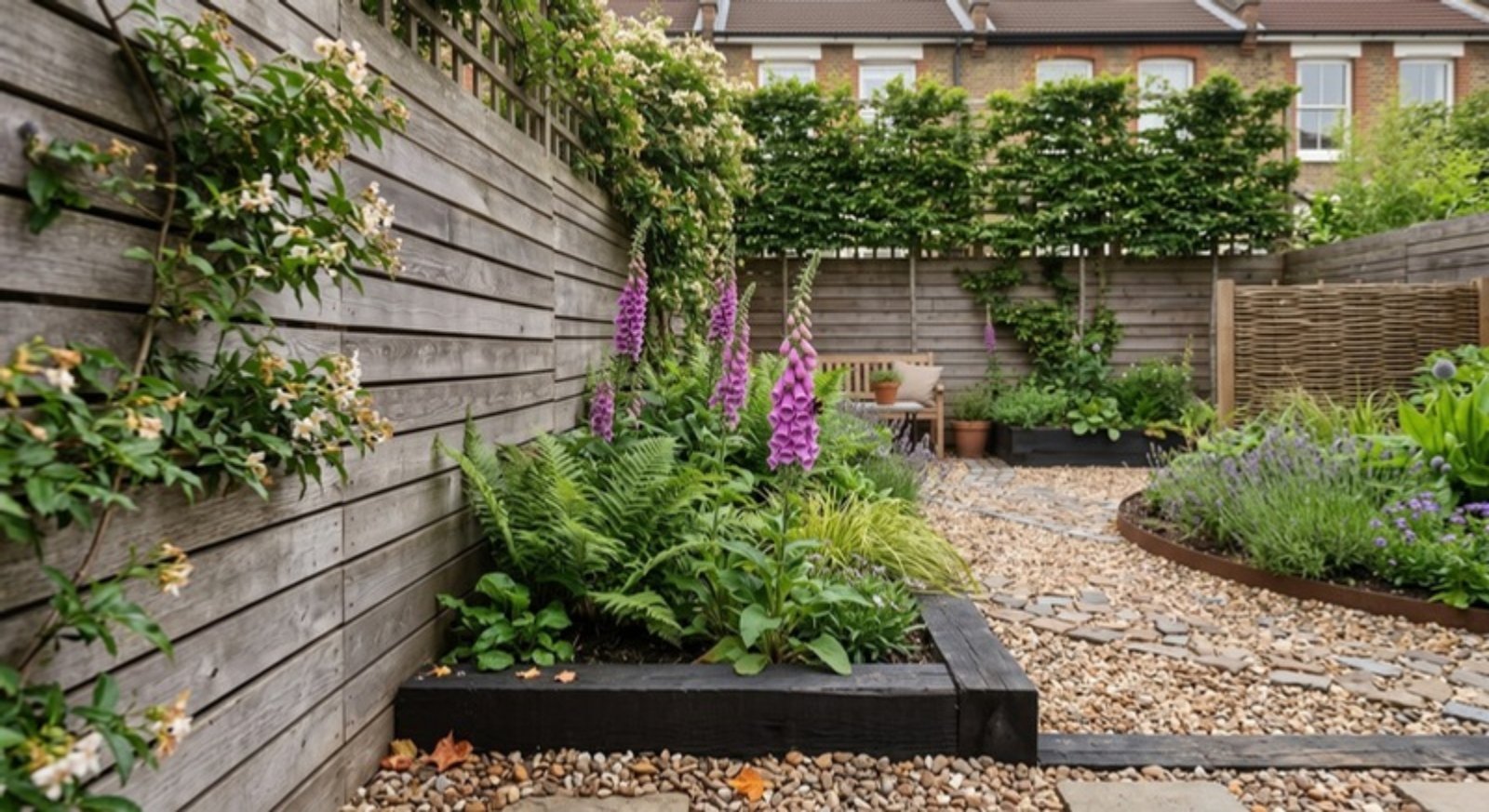
Multi-stem trees give a softer, more natural look. Placed between the window and your seat, a single tree can do an extraordinary amount of work. Amelanchier lamarckii has spring blossom and brilliant autumn colour, and Betula utilis var. jacquemontii has those white stems that glow in low winter light. Both have light canopies, so you get privacy without plunging your garden into gloom.
A word on hedges: a tall line of evergreens can feel like the obvious answer, but evergreen hedges over two metres can become a source of neighbour disputes, and they take a lot of trimming to keep in shape. Pleached and multi-stem trees usually give you privacy more gracefully.
Layers make a garden feel enclosed, not hidden
There’s a difference between being hidden and feeling enclosed, and the second is what makes a garden feel restful.
Layers of planting do this beautifully. Taller grasses like Calamagrostis × acutiflora ‘Karl Foerster’ at the edge of a seating area, a shrub or two with some height, a climber on the fence behind: none of them block a view on their own, but together they break up sightlines and make the space feel held. Your eye stops at the planting instead of travelling up to the window.
Sound helps too. A small water feature near the seat masks conversation, which is a lovely thing when you’re also slightly overlooked by ears as well as eyes.
What it looks like when it’s done well
The best compliment an overlooked garden can get is that nobody notices the privacy at all. They just notice the nicest seat in the garden: under a canopy of leaves, a tree beyond, planting brushing past your ankles. The window is still there. You’ve just stopped thinking about it.
The window isn’t going anywhere. Luckily, neither are the trees.
Where to start with your own garden
If you’re overlooked and unsure what would work, here’s a gentle way in:
- Stand at the window’s height if you can, or take a photo from your upstairs window looking into your own garden. It tells you a lot.
- Decide where you most want to be. Morning coffee, a Pilates mat on the lawn, a glass of wine after a round of golf, reading in the shade.
- Think about the season. Year-round cover, or mainly summer?
- Check the space for underground services before planning trees, and give roots room away from foundations.
And if you’d like a hand, that’s exactly what I’m here for. Every garden I design in Worthing and across Sussex starts with listening to how you want to live in it, and privacy is often high on that list. A Discovery Call is a relaxed first chat, with no obligation, about your garden and what’s bothering you about it. If you’d like me to come and see the space in person, a Garden Clarity Visit gives you a clear plan of what to do next.
You can read more about how I work on garden design in Worthing and the services I offer.
Your garden should feel like yours again. It usually takes less than you’d think.
Ready to Talk About Your Garden?
Every garden transformation starts with a conversation. Book a free Discovery Call and tell us about your space.
Book a discovery call Send us a message