
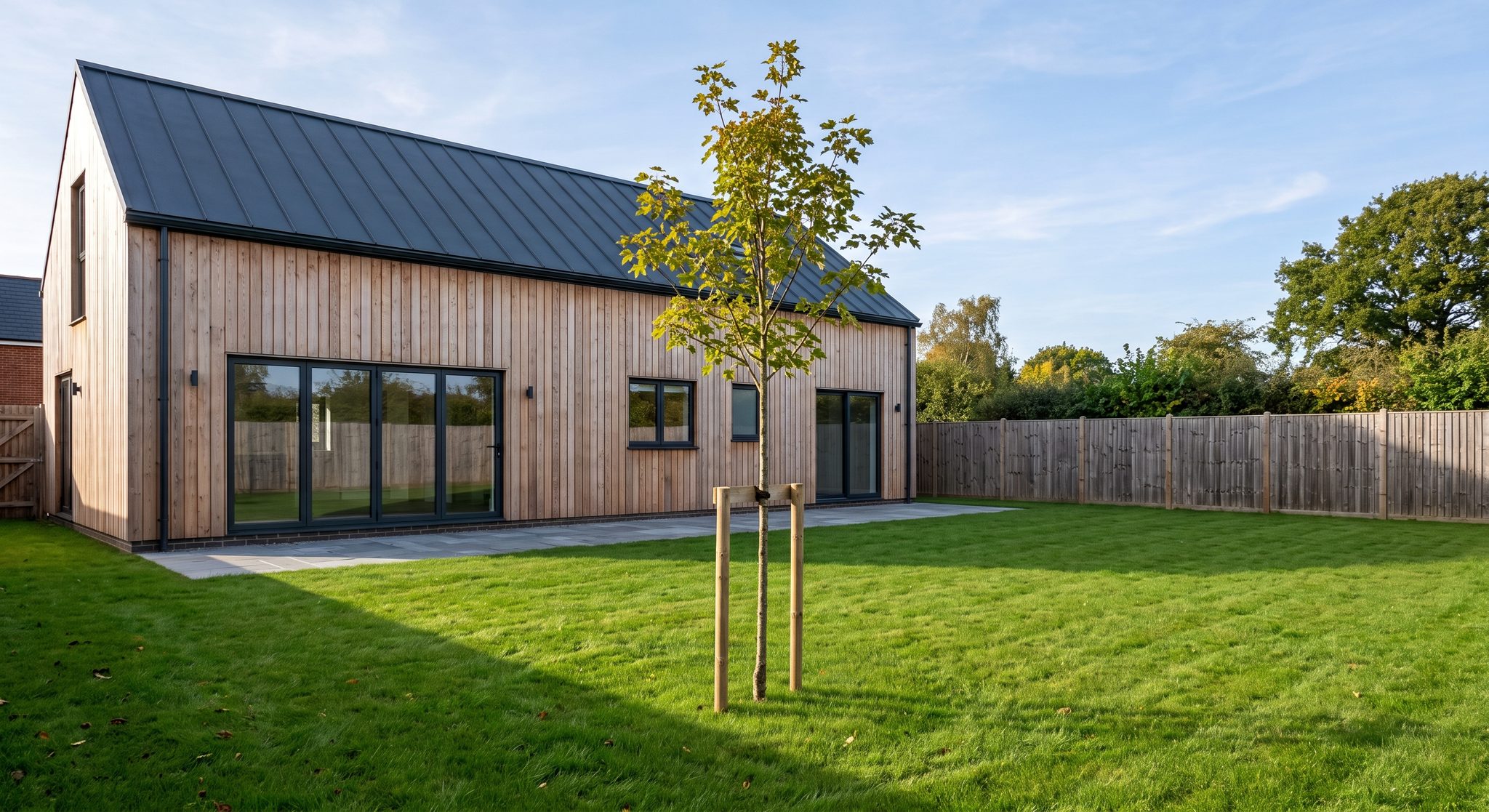
New Build Garden: Where to Start When It’s a Blank Canvas
“We moved from a big established garden to a new build. It’s a blank canvas and we don’t know where to start.”
I hear some version of this every few weeks, and I always feel a little tug of sympathy. Moving is exciting, but leaving a garden you’ve loved is a real loss. The old one had decades of decisions already made for you: the tree you sat under, the hedge that grew just high enough, the border that looked after itself. The new one has a rectangle of turf, a fence and a patio slightly too small for a table.
Here’s the reassuring part. A blank canvas is the best possible start for a new build garden. There’s nothing to undo, and every choice can be made with you in mind, rather than inherited from someone else. You don’t have to work it out all at once, and you certainly don’t have to work it out alone.
This is the order I’d go in.
1. Before anything else, get to know the soil
It isn’t the glamorous bit, but it’s the one that decides whether everything else thrives.
New build plots are often finished quickly. What looks like a garden can be a thin layer of topsoil laid over ground that’s been compacted by months of diggers and delivery lorries, sometimes with builders’ rubble mixed in. Turf laid on top of that tends to go boggy in winter and parched in summer, because water can’t drain down and roots can’t grow down.
An afternoon with a spade tells you a great deal. Dig a few holes around the garden. How deep is the dark, crumbly topsoil? What’s underneath it? Does water sit in the hole after rain?
In Sussex the answer varies enormously. Closer to the Downs you may be on thin chalky soil that drains in a heartbeat. Around Horsham it’s often heavy Wealden clay. On the coastal plain around Worthing and Chichester there’s everything in between. Knowing which you have shapes every plant choice that follows, and it’s far easier to fix the ground before anything is planted than after.
2. Think about structure: the bones an established garden gave you
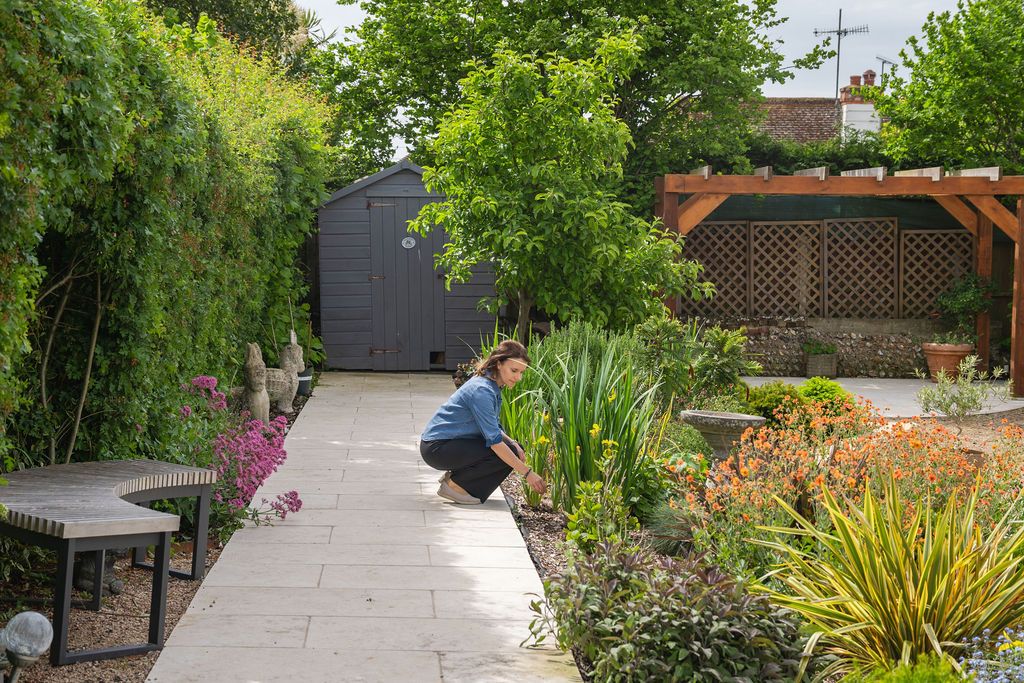
What most people miss about their old garden isn’t the flowers. It’s the feeling of being held: height, enclosure, shade, a sense of rooms.
A new build hands you none of that, so structure comes first.
A tree. Even in a small garden, one well-chosen tree changes everything. It gives height, shade, birdsong and a sense of maturity years before the rest catches up. Planting a semi-mature tree gives you a head start. Amelanchier lamarckii is lovely in a smaller space: blossom in spring, berries for the birds, brilliant autumn colour.
Boundaries. New build fences tend to be close-board panels, practical and not especially pretty. Climbers, pleached trees or a hedge planted just inside them turn a boundary into a backdrop. If you’re overlooked, which new builds often are, I’ve written about how to make an overlooked garden feel private again.
Levels and paths. Where you walk, and whether there’s a step or a gentle change of level, gives a flat plot a sense of journey. A path that leads somewhere is an invitation to go and use the whole garden, not just the patio outside the back door.
3. Decide where you’ll actually spend your time
This is where your new garden starts to become yours.
Watch where the sun falls through the day. The patio the developer put right outside the back door isn’t always where the evening sun lands. Often the best spot for a glass of wine at 6pm is further down the garden, and a second seating area there can become the place you head for without thinking.
Think about how you want to live out there now, in this new chapter:
- Somewhere for morning coffee.
- A level, sheltered corner for a Pilates mat or a stretch in the sunshine.
- A table big enough for the family when they visit, with space on the lawn for grandchildren to run about.
- Planting that looks after itself while you’re on the golf course, or away travelling, rather than sulking until you come home.
That last point matters. Low maintenance isn’t the same as low interest. A well-planned scheme of shrubs, grasses and long-flowering perennials can look good in every season with a sensible tidy-up a few times a year.

4. Then the planting, and it grows faster than you’d think
Planting comes last, and it’s the most enjoyable part. With the soil prepared and the structure in place, plants establish quickly. Many people are amazed how full a new border looks by its second summer.
If you’ve come from a large established garden, you might find you want to bring something of it with you. A favourite rose, a division of a perennial from the old border, the same scent by the back door. I love weaving those into a new design. It makes the new garden feel like home from the very first season.
A few new build practicalities
These are the things that can catch people out, and they’re easy to handle when you know about them:
- Check your deeds. Some new estates have covenants about what you can do, particularly in front gardens.
- Drainage. New build gardens can be wetter than you’d expect. Permeable paving and generous planting beds help water soak away rather than sitting on the lawn.
- Front gardens. Paving over a front garden with an impermeable surface can need planning permission, so it’s worth planning surfaces carefully.
- Services. Know where cables, pipes and any soakaways run before you plant trees or dig foundations for a garden room.
You don’t have to do it all at once
One of the kindest things you can give a new garden is a plan. A plan lets you see the whole picture, make the big decisions once, and then build it in stages if you’d like to. Nothing gets dug up later because it was in the wrong place, and every stage adds to the one before.
I design every garden in 3D, so you can walk through it before a spade goes in the ground. It’s the part clients tell me gives them the most peace of mind. You can see exactly where the tree will cast its shade and how the terrace will feel with the table on it. You can change your mind while changing your mind is free.
The old garden took years to become what it was. The new one can feel like home much sooner than that.
Where to start with yours
If you’ve moved recently and you’re looking at a blank canvas, I’d love to help you make sense of it. A Discovery Call is a relaxed first chat about your garden and how you’d like to use it. If you’d like me to come and see it, a Garden Clarity Visit gives you clear, practical next steps for your space.
You might also enjoy my thoughts on designing a garden when you downsize, or read more about garden design in Worthing.
Every established garden you’ve ever loved started as a blank canvas too.
Ready to Talk About Your Garden?
Every garden transformation starts with a conversation. Book a free Discovery Call and tell us about your space.
Book a discovery call Send us a message