
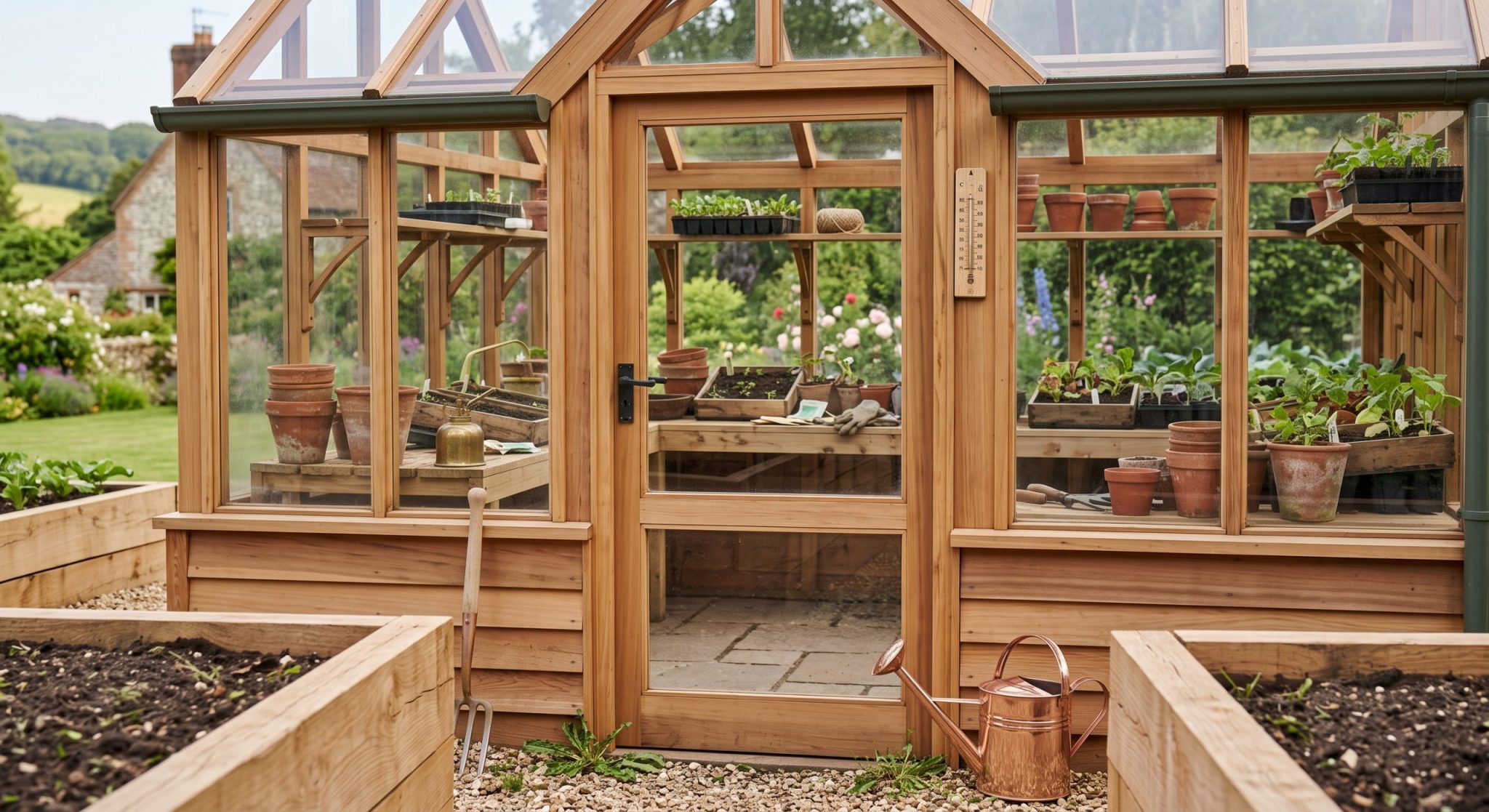
Where to Put a Greenhouse: A Garden Designer on Getting the Spot Right
A client told me recently that her mum had a greenhouse. Since losing her, she wanted one of her own: somewhere to feel close to her, and to the hobby they shared. She’s learning to grow vegetables now, and she wants to pass it on to her children.
Some briefs are about space and light. That one was about love, and it has stayed with me. A greenhouse with that much meaning could never be tucked behind the shed because the shed happened to leave a gap.
And yet that’s where most greenhouses end up. It’s the question I’m asked about more than any other once a greenhouse is on the wish list: where to put a greenhouse so it actually gets used. The honest answer is that the spot matters more than the model. A modest greenhouse in the right place will give you years of pleasure. A beautiful one in the wrong place becomes a very expensive cupboard for empty pots.
Here’s how I work it out.
Follow the winter sun, not the summer one
In July almost anywhere in a garden is bright. The test is November to March, when the sun barely clears the fence and the garden’s shadows are at their longest. That’s when a greenhouse earns its keep: raising seedlings in February, keeping tender plants through a frost, giving you a head start in spring.
So I site greenhouses with the ridge running east to west where the plot allows. The long side then faces south and catches the low winter sun across its full length, rather than presenting one narrow end to it.
This is also why late autumn is a good time to decide. Stand in the garden on a clear November afternoon and watch where the shade from the house, the neighbour’s extension and that lovely birch actually falls. A spot that looks perfect in summer can sit in shadow for half the day from now until March.
Watch out for trees and frost pockets
Two things catch people out once the greenhouse is built.
Trees. Even a tree that doesn’t shade the glass can cause trouble. Leaves block the gutters, sticky honeydew from aphids lands on the roof and turns grey, and a falling branch in a winter gale is not something glass forgives. I like a few metres of clear sky around a greenhouse, with any trees to the north of it rather than the south.
Frost pockets. Cold air is heavier than warm air, so on a still winter night it flows downhill and settles at the lowest point it can find, particularly where a solid fence or hedge at the bottom of a slope stops it draining away. On the gentle slopes you find across the Downs, the bottom of the garden can be several degrees colder than the terrace by the house. A greenhouse sitting in that pool of cold air has to work much harder to keep anything alive.
Shelter without shade
Wind strips heat from glass faster than cold air alone, so an exposed greenhouse is a cold greenhouse. That matters anywhere in Sussex, but it really matters near the coast in Worthing, Lancing or Shoreham, where the wind arrives straight off the sea with salt in it.
The instinct is to put up a solid wall or close-boarded fence. The trouble is that wind doesn’t stop at a solid barrier. It goes over the top and tumbles down on the other side in eddies, often right where you didn’t want it. A hedge or a slatted screen filters the wind instead, slowing it down without the turbulence.
So I’ll often place a greenhouse with a hedge some way off on the windward side, far enough away that it doesn’t shade the glass. Griselinia littoralis is a good choice by the sea because its thick, waxy leaves shrug off salt spray. Further inland, beech (Fagus sylvatica) or hornbeam (Carpinus betulus) hold on to their dry brown leaves through winter, which keeps the shelter going when you need it most.
Closer to the house than you’d think
This is the decision that most affects whether a greenhouse is a joy or a chore.
In May you’ll happily wander to the far end of the garden twice a day. In January, with the rain coming sideways, you won’t. Nobody has ever walked forty metres in slippers to check on a seed tray in February. The closer the greenhouse is to the door you actually use, the more you’ll use it, especially in the months when it matters most.
Being close to the house helps in practical ways too:
- Water. Seedlings need watering every day in warm weather. A tap within reach saves endless trips with a can, and a water butt fed from the greenhouse gutter gives you rainwater on the spot.
- Power. If you’d like a heated propagator, a little frost protection or a light for winter evenings, you’ll need an electric supply. A long cable run across a finished garden means lifting paving and lawn.
- Paths. A firm, level path that’s wide enough for a wheelbarrow, and dry underfoot all year, makes the greenhouse part of daily life rather than an expedition.
This is where planning the greenhouse as part of the whole design really pays off. The water pipe and the cable go in before the paving, not after it. Done in the right order, nobody ever sees them.
A south-facing wall is a gift
If you have a warm, sunny wall, a lean-to greenhouse can be the best spot of all. The brickwork soaks up the sun during the day and gives the heat back overnight, so a lean-to stays warmer than a freestanding greenhouse in the same garden. It’s how the walled kitchen gardens of old country houses grew peaches and figs in an English climate.
A lean-to also takes up less room, sits close to the house by definition, and often looks more at home against period brick than a freestanding structure would.
Make it part of the garden, not an afterthought
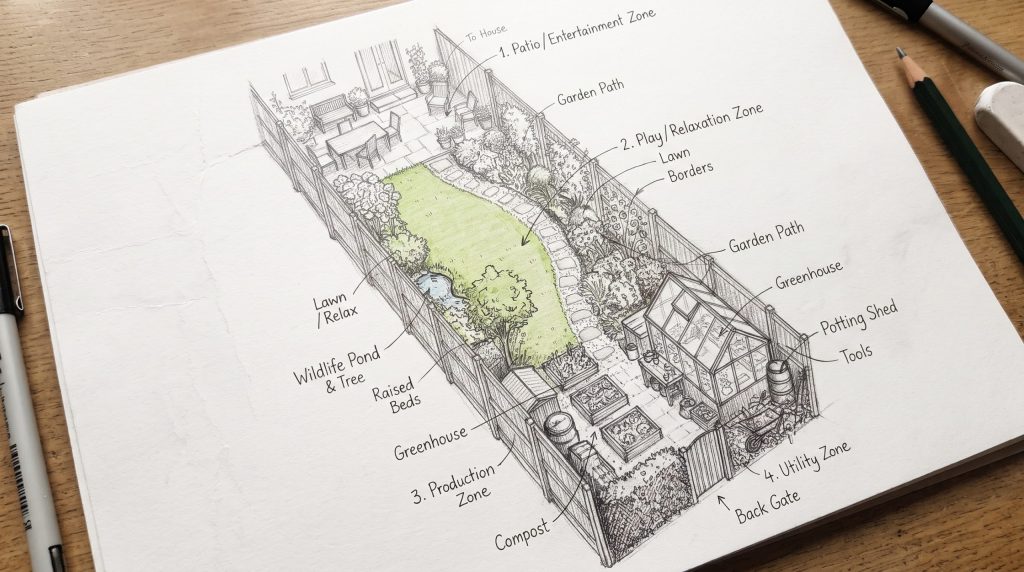
A greenhouse is one of the few structures in a garden that people actually want to look at. So I’d rather design it in as a feature than hide it away.
That might mean putting it at the end of a path, so it becomes a destination with a reason to walk down the garden. It might mean framing it with raised beds and a bench, so the growing area feels like a little room of its own. Choosing the frame colour matters more than people expect: a dark green or black frame recedes into the planting, while bright aluminium catches the eye from every window in the house.
Material affects the feel, too. Western red cedar has natural oils that help it resist rot, and it weathers to a soft silver-grey that sits well in a planted garden. Powder-coated aluminium needs almost no maintenance and gives slimmer glazing bars, so more light gets in.
If children will be growing too
For my client, passing it on to her children mattered as much as the growing, and that brings its own design decisions.
Glazing. Traditional horticultural glass breaks into long, sharp shards. Toughened safety glass breaks into small, blunt pieces, and polycarbonate is lighter and won’t shatter at all, though it’s not quite as clear. Where small people and footballs are involved, I’d always choose one of the safer two.
Raised beds alongside, at a height a small child can reach without climbing in. On the thin, chalky soil you find over much of Sussex, raised beds also give vegetables the depth of good soil they need, rather than a few centimetres of topsoil over chalk that drains before you’ve finished watering.
Somewhere to sit. Children wander off; adults need a perch. A bench by the door makes it a place to spend time, not just a place to work.
There’s more on getting children into the garden in an earlier post.
My own grandparents in Austria had raised vegetable beds and an orchard, and grafted their own fruit trees. I spent my childhood playing between those beds without much interest in what was growing in them. It took me years to realise how much of it stuck.
A quick note on permission
Greenhouses usually fall under permitted development, so most don’t need planning permission. There are limits, though, on height close to a boundary and on building in front of the house, and the rules are different in a conservation area or for a listed building. I check this at the design stage so it never becomes a surprise later.
Where to start with your own garden
If a greenhouse is on your wish list, a few things will tell you a lot before anything is bought:
- Watch the shadows on a sunny afternoon this winter. Note where the sun still reaches at three o’clock.
- Walk from the back door to the spot you have in mind, in the rain. Be honest about whether you’d do it every day.
- Look for the low point of the garden and the direction the wind comes from.
- Think about who it’s for. Seed trays for one, or a growing space for the whole family?
And if you’d like a hand, that’s exactly what I’m here for. Whether it’s a new build garden that’s a blank canvas or a garden you’ve loved for years, every design I create in Worthing and across Sussex starts with listening to how you want to live in it. A Discovery Call is a relaxed first chat, with no obligation, about your garden and what you’d love from it. If you’d like me to come and see the space in person, a Garden Clarity Visit gives you a clear plan of what to do next.
You can read more about what to expect from working with a garden designer and how I work on garden design in Worthing.
A greenhouse in the right place gets used every day. That’s how a hobby gets passed on.
Ready to Talk About Your Garden?
Every garden transformation starts with a conversation. Book a free Discovery Call and tell us about your space.
Book a discovery call Send us a message